NHS Greater Glasgow and Clyde leads new study using AI to improve lung cancer diagnosis
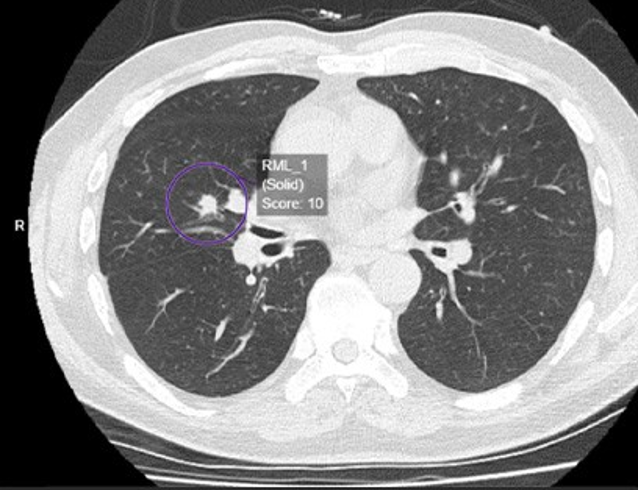
NHS Greater Glasgow and Clyde is playing a leading role in a new study exploring how artificial intelligence (AI) can support earlier diagnosis of lung cancer and improve patient safety.
The SWIFT-Lung study will test a new digital platform designed to help clinicians identify and assess patients with lung nodules more quickly and accurately.
The aim of the SWIFT-Lung study is to demonstrate the impact of AI-enabled triage in routine NHS care focussing on earlier lung cancer diagnosis, reduced waiting times, and ultimately improved outcomes for patients.
Lung cancer remains the most common cause of cancer-related death in the UK, and earlier diagnosis is key to improving survival rates.
This study brings together NHS Greater Glasgow and Clyde, the West of Scotland Innovation Hub, the University of Glasgow’s HealthTech Innovation and Translation Lab, NHS Highland, Oxford University Hospitals NHS Foundation Trust and UK health technology company Optellum.
At the centre of the study is the Optellum Virtual Nodule Clinic, an AI-enabled system designed specifically to support earlier lung cancer diagnosis and improve how lung nodules are managed.
A key element of the platform is its Patient Safety Net AI, which automatically highlights patients with lung nodules from CT scan reports, for clinical follow up.
This means no patient is missed or lost in the system, helping to ensure that those who may need further investigation or follow up are flagged promptly and tracked through their care pathway.
Alongside this, the system uses an AI‑powered Lung Cancer Prediction (LCP) model. This model calculates a personalised risk score to assess the likelihood that a lung nodule could be cancerous, supporting clinicians to prioritise those at highest risk for urgent follow-up.
Together, these tools aim to reduce delays in diagnosis, while avoiding unnecessary investigations for patients with non-cancerous findings.
Within NHS Greater Glasgow and Clyde, the platform will be integrated into existing lung cancer and lung nodule pathways as part of the study.
By automatically flagging potentially concerning findings and ensuring consistent follow-up, the approach is designed to improve patient safety and reduce anxiety, while also supporting clinical decision-making and streamlining care.
Dr Mark Hall, NHS Greater Glasgow and Clyde Consultant Radiologist and Chief Investigator for SWIFT-Lung, said: “Pulmonary nodules are commonly identified on CT scans, but ensuring every patient receives the right follow-up at the right time remains a major challenge across healthcare systems. SWIFT-Lung aims to close that gap by using AI to help identify, risk assess and track patients through a structured pathway.
“This is about giving radiology and lung cancer teams better tools to manage complex information, reduce variation, and improve patient safety. not replacing clinical judgement or radiologists."
Dr John MacLay, Lung Cancer Lead at Glasgow Royal Infirmary and Clinical Lead for SWIFT-Lung, said: “We hope that SWIFT-Lung will demonstrate the real-life utility of Optellum's Virtual Nodule Clinic, ensuring all pulmonary nodules identified and reported on CT scans are reviewed and appropriate follow up is implemented.
"This AI-driven solution has the potential to reduce the clinical risk of missed nodules that may represent early lung cancers and accelerate the diagnostic pathway to allow early curative intervention.”
Professor David Lowe, Director of Clinical Innovation at the University of Glasgow and Lead of the HealthTech Innovation & Translation Lab, said: “Despite advances in imaging and pathway design, a substantial proportion of lung cancers in the UK are still diagnosed at a late stage.
“SWIFT-Lung addresses this by generating robust, real‑world evidence on whether AI-enabled triage approaches - such as Optellum’s Virtual Nodule Clinic - can be safely and effectively integrated into routine practice to support earlier identification of high-risk nodules.
“The study focuses on measurable impact, including time to triage, time to diagnosis, and the timely escalation of patients with high‑risk findings.
“This is about helping clinical teams to ensure that actionable findings are identified promptly and not missed, ultimately improving outcomes for patients.”
Dr Johnathan Watkins, PhD, Optellum's CEO, said: “Optellum is honoured to have been selected and trusted for the SWIFT-Lung project to help NHS teams improve lung cancer care pathways.
“This project shows how committed we are to supporting health systems with responsible, evidence-based innovations that have real-world impact for patients and providers.
“Most importantly, we want to help patients get the timely care they need and potentially reduce the uncertainty that often comes with receiving a lung cancer diagnosis."